Nail and lash customers come back on a cycle: a lash fill every two to three weeks, a gel infill every three to four. That makes packages and memberships a natural fit. Sold well, they bring in cash up front, fill your book with regulars and make it harder for a customer to drift to the studio down the road. Sold badly, they turn into discounts you can't afford, arguments about expiry dates, and a pile of prepaid sessions you still owe.
This guide compares the three main options for nail and lash studios, works through pricing examples, and lists the pitfalls to avoid. All prices below are made-up round examples in RM to show the arithmetic, not recommended prices.
Three ways to sell prepaid loyalty
- Session packages: a fixed number of a service, such as 5 lash refills or 6 gel infills, with an expiry date.
- Prepaid credit (stored value): the customer tops up an amount, often with a bonus, and spends it on any service or product.
- Memberships and subscriptions: the customer pays a recurring fee, usually monthly, for included services, member prices or both.
Many studios use two of these together: refill packages for lash customers and prepaid credit for everyone else, for example.
Refill and infill packages
Packages work best for services that repeat on a predictable cycle.
Example (lash refills): A lash refill is normally RM 90. You sell 5 refills for RM 400, valid for 4 months.
- Normal price for 5 = 5 × RM 90 = RM 450
- Customer saves RM 50, about 11%
- Value per session = RM 400 ÷ 5 = RM 80
Example (gel infills): A gel infill is normally RM 100. You sell 6 for RM 540, valid for 6 months.
- Normal price for 6 = RM 600
- Customer saves RM 60, which is 10%
- Value per session = RM 90
Set the validity to match the cycle with some slack. Five refills at three-week intervals take about 12 to 15 weeks, so 4 months gives a little room for holidays. If the expiry is too tight, customers feel cheated; if there is no expiry, unused sessions stay on your books for ever.
Check your margin at the package price, not the normal price. If a technician earns 30% of service value and product costs about RM 8 per infill, then at RM 90 the studio keeps RM 90 − RM 27 − RM 8 = RM 55 per session, compared with RM 100 − RM 30 − RM 8 = RM 62 at full price. That's fine if the package brings in visits you wouldn't otherwise get, but it adds up if every regular switches to the package.
Prepaid credit with a bonus
Prepaid credit is more flexible: customers can spend it on any service, add-on or retail product.
Example: "Top up RM 500, get RM 50 free."
- Customer pays RM 500 and can spend RM 550
- The real discount is RM 50 ÷ RM 550 = about 9.1% (not 10%), because the bonus is spread over everything the customer buys
Common choices to make:
- Bonus tiers, for example RM 30 bonus on RM 300, RM 80 on RM 600.
- A minimum top-up, so small top-ups don't get a bonus.
- Bonus expiry: many studios let paid credit last much longer than the bonus. Check local rules before you set any expiry on paid credit.
- Refunds: decide whether unused paid credit can be refunded and whether the bonus is removed first.
In your books, a top-up is money received in advance, not a sale. The sale happens when the credit is spent. Mixing the two makes good months look great and the following months look terrible.
Monthly memberships and subscriptions
A subscription bills the customer automatically, usually monthly, by card. It suits studios with regulars who come at least once a month.
Example: A "Gel Club" at RM 99 a month includes one gel manicure (normally RM 110) and 10% off nail art add-ons, with a 3-month minimum term.
- Included value = RM 110 for RM 99, so the member saves RM 11 a month plus the add-on discount
- Over the 3-month minimum, the studio receives RM 297 in steady income
- If the member misses a month, decide whether the manicure rolls over (for example, up to one month) or is lost
Things to decide before you launch:
- What is included: one service, a credit amount, a member discount, or a mix.
- Rollover: unused visits that roll over forever turn into a liability; a short rollover window is fairer to both sides.
- Minimum term and notice period: write them down and show them before the customer signs up.
- Card payments: recurring card billing goes through a payment provider, which charges its own fees; include them in your price.
Our salon membership guide covers rollover, cancellation and churn in more depth.
Pitfalls to avoid
- Stacking discounts. A package price plus a member discount plus a promo code can leave you working at a loss. Decide which discounts can be combined.
- Paying commission on the normal price. If a technician earns a percentage, use the package's discounted value per session. Our commission guide shows the maths.
- Counting prepaid money as sales. Package sales and top-ups are money you still owe in services. Track the unused value.
- Vague terms. Write down validity, whether a package can be frozen (for travel or pregnancy), transferred to a friend, or refunded, and show this before payment.
- Refill rules nobody explained. Many lash studios only charge the refill price within a set number of weeks, or if enough lashes remain, otherwise they charge a new full set. If that is your rule, say so when you sell the package.
- Add-ons in the grey zone. Say clearly whether art, chrome or removal of another studio's work is included.
- Paper cards. Stamp cards and notebooks get lost and can't show you who is about to expire. If you are moving to software, import the remaining balances on day one.
How Senvia POS handles packages, credit and memberships
At the time of writing, Senvia POS offers:
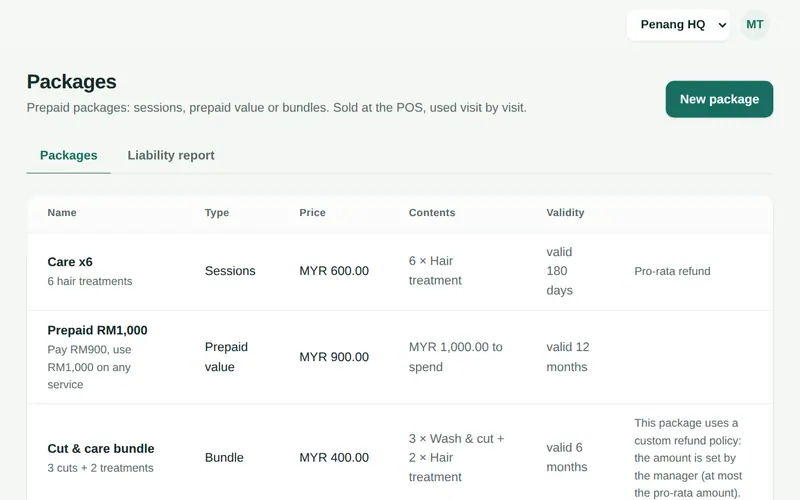
- Packages as sessions, prepaid value or bundles, with terms for validity, freezing, transfer, refund policy, commission and branches. A sold package keeps the terms it was sold with, and a package report shows sold, used, expired and unused value.
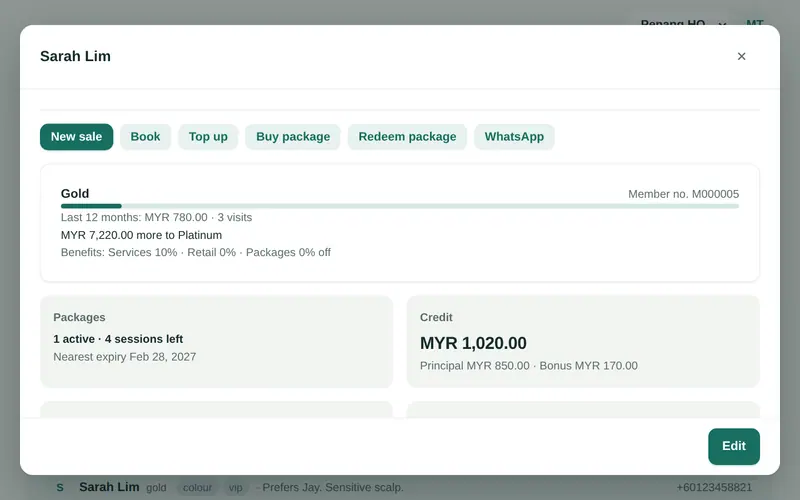
- Store credit with top-up bonus tiers, a minimum top-up, bonus expiry and refund settings. Top-ups are recorded as a liability; revenue counts when the credit is used.
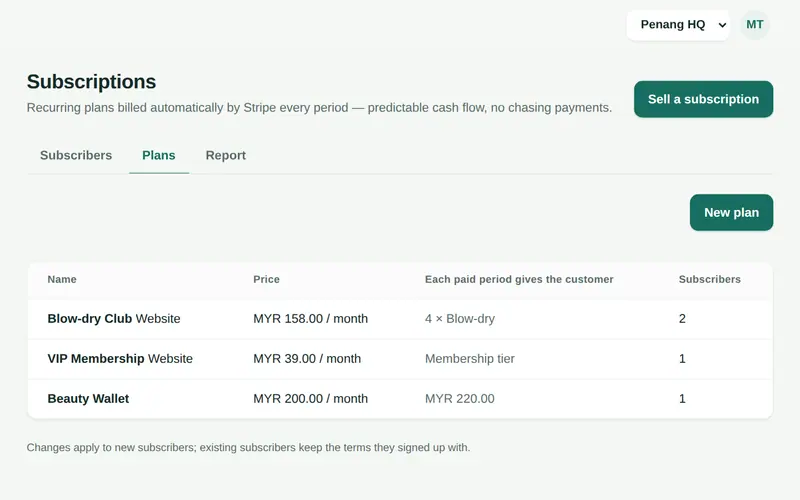
- Subscriptions (Full plan, on your own Stripe account): weekly, monthly or yearly plans that grant session credits, a package, a membership tier or stored value, with rollover, minimum term, notice period, trial, sign-up fee and commission settings, plus a report with MRR, churn and failed payments. Senvia charges a small fixed fee per successful recurring charge; the current amounts are on the subscriptions page.
- Membership tiers with discounts on services, products and packages, plus points and vouchers.
- Member centre filters such as sessions left or packages expiring within a number of days, so you can remind customers before they lose sessions.
See the nails and lashes page, the packages and credit help guide and our guide to choosing a nail and lash studio POS in Malaysia. Plans start at USD 25.90/month at the time of writing, with a 30-day free trial and no card needed; see pricing for current details.