
In a massage or foot reflexology centre, therapist pay is usually built from small pieces: a fixed amount per session, a little more when the customer asked for that therapist, something extra for add-ons, and sometimes a basic salary on top. Each piece is simple. The trouble starts when nobody has written down how they fit together, and the counter, the therapists and the owner each remember the rules differently.
This guide walks through the common ways to pay massage and reflexology therapists and shows how to calculate each one. All numbers below are made-up round examples in RM to show the arithmetic. They are not recommended rates. Your rates depend on your prices, your location, your basic salary and the law that applies to your staff.
Two basic models: flat fee per session or percentage
Flat fee per session
Many massage and reflexology centres pay a fixed amount for each session (钟) a therapist completes, with different amounts for different services or durations.
Example: A centre pays RM 12 for a 60-minute foot reflexology and RM 25 for a 90-minute body massage. In one month a therapist completes 110 foot sessions and 30 body massages.
- Foot reflexology = 110 × RM 12 = RM 1,320
- Body massage = 30 × RM 25 = RM 750
- Total session pay = RM 2,070
A flat fee is easy to understand: therapists can count their own sessions and know what they earned. The downside is that it doesn't follow the price. If you raise prices, run a promotion or give a member discount, the therapist is paid the same, so the business absorbs (or keeps) the whole difference.
Percentage of the service price
Some centres pay a percentage of what the customer paid for the service, usually after discounts and excluding tax.
Example: A therapist earns 35% of net service sales. In a month the services she performed were listed at RM 7,000, and customers received RM 400 in discounts.
- Net service sales = RM 7,000 − RM 400 = RM 6,600
- Commission = RM 6,600 × 35% = RM 2,310
A percentage moves with your prices and shares discounts between the business and the therapist. It is a bit harder for therapists to check from memory, so it matters more that they can see their own figures.
Which one?
Flat fees suit centres with a short, stable menu and lots of walk-ins, especially foot reflexology. Percentages suit centres with a wide price range (from a RM 50 foot session to a RM 300 spa package) or frequent promotions. Some centres use both: flat fees for standard sessions and a percentage for premium treatments and retail.
Requested sessions (点钟 / 指定)
When a customer asks for a specific therapist, many centres reward that therapist, because repeat customers are good for the business.
There are two common setups:
- A request bonus paid by the centre, for example RM 3 extra per requested session.
- A request fee charged to the customer (for example RM 5), with all or part of it passed to the therapist.
Example (bonus): A therapist completes 140 sessions in a month; 25 of them were requested. The request bonus is RM 3.
- Request bonus = 25 × RM 3 = RM 75
Decide whether a requested session also changes the therapist's place in the rotation (轮钟). Many centres say it doesn't, so therapists with many regulars don't also take an unfair share of walk-ins. Whatever you decide, write it down.
Extensions (加钟) and add-ons
An extension is extra time sold during the session, for example a customer who adds 30 minutes. Treat it as its own line on the bill with its own commission, so the therapist is paid for the extra time and your reports show how much extension time you sell.

Add-ons such as hot stones, herbal compresses (药包), a scrub or a longer head-and-shoulder segment often carry a small flat commission of their own.
Example: In a month a therapist sells 20 extensions of 30 minutes (paid at RM 6 each) and 15 hot-stone add-ons (paid at RM 5 each).
- Extensions = 20 × RM 6 = RM 120
- Hot-stone add-ons = 15 × RM 5 = RM 75
- Total = RM 195
Packages and stored-value cards
Prepaid packages and stored-value cards are common in Malaysian massage and reflexology. The rule of thumb is simple: pay service commission when the session is done, not when the card is sold, unless your policy says otherwise.
Example (package): A customer buys 10 foot reflexology sessions for RM 450 (normal price RM 50 each). The therapist earns a flat RM 12 per session.
- With a flat fee, the therapist earns RM 12 each time a package session is done, the same as a normal session. Ten sessions = RM 120.
- With a percentage (say 35%), use the discounted per-session value: RM 450 ÷ 10 = RM 45, so RM 45 × 35% = RM 15.75 per session. Don't use the normal RM 50 price, or you pay commission on money the centre never received.
Some centres also pay a small sales commission to whoever sold the package (for example 3% of RM 450 = RM 13.50), on top of the service commission for whoever does each session.
For stored-value cards, the top-up itself is prepaid money, not a sale. Service commission is earned when the credit is spent on a session. Our stylist commission guide covers package timing in more detail.
Four-hand massage and shared sessions
When two therapists work on one customer, decide in advance how to split. The simplest rule is 50/50 of the session's commission. If one therapist does most of the work, use a fixed split, such as 60/40.
Example: A four-hand massage pays RM 40 commission in total. Split 50/50, each therapist earns RM 20.
Overtime and working hours
Commission isn't the only thing to get right. If a therapist has a basic salary or an hourly rate, the hours they work, including overtime and rest-day or public-holiday work, may have to be paid under employment law. In Malaysia, the rules depend on the employee and on where they work (for example, the Employment Act 1955 in Peninsular Malaysia, with separate laws in Sabah and Sarawak), and statutory contributions such as EPF and SOCSO apply on top. Please check with your accountant or the Labour Department (JTKSM) rather than relying on a commission spreadsheet.
A full month: putting it together
Here is one therapist's month, using the made-up rates above. She also has a basic salary of RM 1,200.
- Basic salary = RM 1,200
- Foot reflexology: 110 × RM 12 = RM 1,320
- Body massage: 30 × RM 25 = RM 750
- Request bonus: 25 × RM 3 = RM 75
- Extensions: 20 × RM 6 = RM 120
- Hot-stone add-ons: 15 × RM 5 = RM 75
- Gross pay before statutory deductions = RM 3,540
Laid out like this, a therapist can check every line against her own count of sessions. That is the real goal: pay that people trust.
A checklist for your commission policy
- Flat fee per session, percentage, or a mix, and for which services
- Whether percentages use the price after discounts and excluding tax
- Request bonus or request fee, and whether it affects the rotation
- How extensions and add-ons are paid
- When package and stored-value sessions earn commission, and at what value
- How shared sessions are split
- How refunds and redone sessions are handled
- Basic salary, hours and overtime, checked against the law that applies
- When pay is calculated and how therapists can check their figures
How Senvia POS handles it
Senvia POS calculates commission from paid sales, using rules you set. Here is what it can do at the time of writing:
- Percentage or fixed amount per item. Each rule has a rate that is either a percentage of the line's value (after discounts, excluding tax) or a fixed amount per item, so a flat fee per session is a fixed-amount rule on that service.
- Rules by line type, service, category, role and staff level. Line types are services, retail, package sales, package sessions, credit top-ups and subscriptions. The most specific rule wins (service > category > role > level), so you can set a general rate and then override it for one service or for senior therapists.
- Package sessions have their own rule type; if you don't set one, package sessions use your service rules. Each package also has its own commission settings.
- Splits at checkout. A line can be split between team members by role and share (adding up to 100%), for example a four-hand massage.
- Tiers for percentage rules, applied to the whole amount or band by band.
- Monthly payroll: basic salary, hourly pay (rate × hours entered), commission, and adjustments for bonuses or deductions (a reason is always required). A manager reviews, the owner approves and locks, and you can export the result. Statutory deductions such as EPF, SOCSO and PCB are not calculated in payroll.
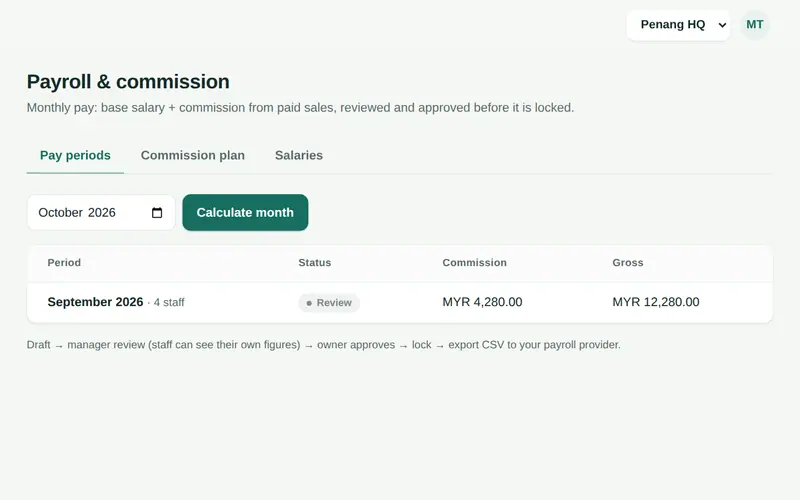
Two things are worth knowing. There is no separate "requested session" flag or rotation queue at the time of writing: if you charge customers a request fee, add it as its own service on the bill with a fixed-amount rule; if you pay a bonus without a fee, add it as a payroll adjustment. And overtime isn't calculated automatically: enter the hours for hourly pay, or add overtime as an adjustment.
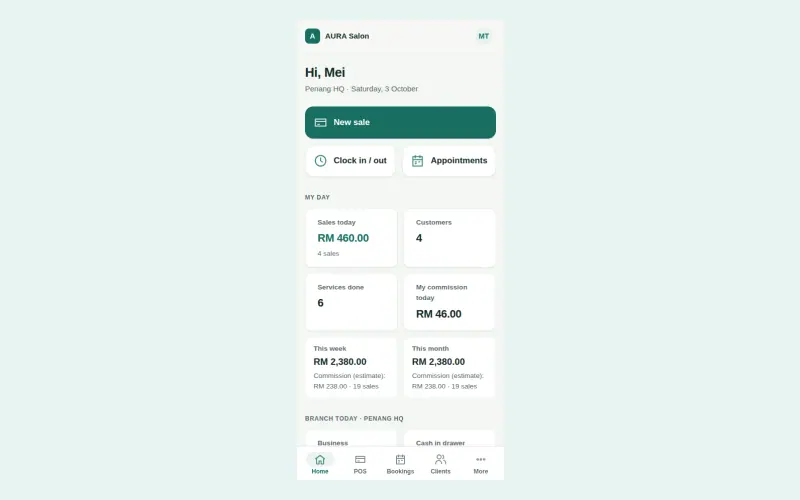
Read more on the payroll and commission help page and the massage and reflexology page, or see our guide to choosing a POS for massage and reflexology centres in Malaysia. Automatic payroll is an add-on on the Base plan and included in Full; see pricing for current details (pricing can change after the time of writing).